Sunday, July 18, 2010

HIV efforts to target military


100716_2
Photo by: Heng Chivoan
Uk Kea (foreground), a soldier stationed at Preah Vihear temple, says he is aware of the risk of HIV infection and does not have sex outside of marriage.

FOR the past three years, Song Phal has awakened every morning in the middle of a simmering dispute. The 49-year-old soldier is posted at the front line in the Preah Vihear temple area, where a border dispute with Thailand has occasionally erupted in firefights.

But for health officials, he and other soldiers here represent a separate front in the battle to contain the spread of the HIV virus.

Soldiers are considered to be at high risk of contracting HIV, and with troops living for long stretches of time in confined quarters in often remote
areas, previous studies have suggested extra caution is needed to prevent the spread of the virus among this group.

Song Phal says there are soldiers who take advantage of the prostitution available in the area.

“Since before the clash, there have been some prostitutes travelling up the mountain to sell their services, or sometimes individual soldiers call them to buy their services,” he said.

For Song Phal though, the risks are too great. He said he never goes down the mountain to look for sex.

“I am more afraid of AIDS than I am of bullets,” he said.

Health officials are now working on a plan to boost HIV-prevention efforts in the area in recognition of the risks stemming from the buildup of troops following recent political tensions.

The National AIDS Authority, the Ministry of Defence, UNAIDS and the health NGO Family Health International are considering implementing an education campaign for soldiers stationed at Preah Vihear.

“For us, we still consider not all, but some soldiers to be high-risk,” said Song Ngak, FHI’s deputy director.

“There are tensions along the border. A lot of military are mobilised and deployed. New recruits may come in. These people may not have received HIV education like the others.”

The scheme is still in the early planning stages, but Song Ngak said the project’s proponents hope to be able to begin information campaigns and peer-support programmes as early as next month if possible.

Military ‘epidemic’
In the late 1990s, soldiers were considered among the most at-risk groups for HIV infection, Song Ngak said. One Ministry of Health survey estimated the HIV prevalence rate among soldiers at 7.1 percent – far above the national average at the time.

“This was one population that was driving the HIV epidemic before 1997,” Song Ngak said. “When they go out they go to karaoke, or go to brothels. That’s the practice normally.”

Authorities and NGOs stepped in with gradual campaigns, encouraging soldiers to drink less and get tested for HIV/AIDS. Using a peer education system involving respected role models, health officials brought HIV education campaigns to individual barracks around the country.

Song Ngak said there has been no recent comprehensive study to gauge HIV prevalence in soldiers, but he believes the education efforts have paid off.

Nationwide, Cambodia has shown success in reducing its HIV prevalence rate among adults to a level that stands at an estimated 0.7 percent this year.

However, with that success comes lingering concerns. The emphasis on HIV education for the military has lessened in recent years, Song Ngak said.

“If the HIV prevalence rate is quite low, people might say it is not the area we need to put our money into, from the donors’ point of view,” Song Ngak said. “The military population will still be the one group I feel that could be left behind. We have to keep our eyes open.”

Officials with the National Aids Authority could not be reached for comment yesterday.

For his part, Uk Kea, 53, believes he and other soldiers are well aware of the risks posed by HIV. “I have never taken services from prostitutes,” he said. “I used to be a monk and I am honest to my wife.”

Saturday, July 17, 2010

US defends military aid to Cambodia after opposition criticism

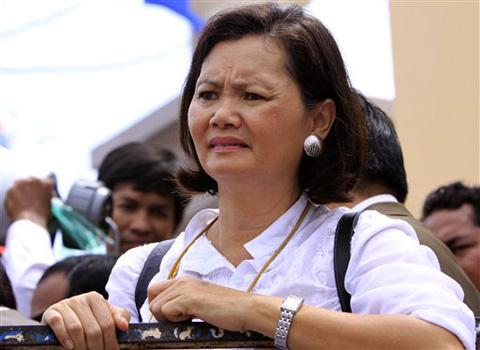
Mu Sochua (Photo: AP)

Sun, 18 Jul 2010
DPA
Mu Sochua said US support for military units have been implicated in human rights abuses was "a huge insult to the people of Cambodia.""So I am extremely disappointed by President Obama for allowing this to happen in Cambodia," Mu Sochua said.

She also accused the US Department of Defense of lying to the US Congress when it said Cambodian military units had not been involved in human rights abuses.
Phnom Penh - A senior US diplomat defended military aid to Cambodia on Sunday, following criticism from a prominent opposition parliamentarian.

William Burns, US under secretary of state for political affairs, said military exercises in Cambodia involving troops from the US and 23 Asia-Pacific nations were part of efforts to improve regional humanitarian and peacekeeping capabilities.

"Any military relationship we conduct around the world is consistent with US law, and so we look very carefully and vet very carefully the participants," Burns said at a ceremony in Phnom Penh to return seven ancient Cambodian artefacts recovered from the US.

The two-week exercise that began July 12 is part of the 2010 Global Peace Operations Initiative, a US-run effort to train peacekeepers.

Burns spoke after opposition legislator Mu Sochua said US support for military units have been implicated in human rights abuses was "a huge insult to the people of Cambodia.""So I am extremely disappointed by President Obama for allowing this to happen in Cambodia," Mu Sochua said.

She also accused the US Department of Defense of lying to the US Congress when it said Cambodian military units had not been involved in human rights abuses.

Mu Sochua said the international community was repeatedly failing in its obligations to Cambodia. She called on donors, who pledged more than 1 billion dollars this year, to impose conditions such as respect for human rights.

Sacrava's Political Cartoon: The Angkor Sentinel

Cartoon by Sacrava (on the web at http://sacrava.blogspot.com)

Additional criticism from Mrs. Mu Sochua on the court and the ruling party

Mrs. Mu Sochua (Photo: Sovannara, RFI)

18 July 2010

By Sopheak
Cambodia Express News
Translated from Khmer by Socheata


Phnom Penh – During a meeting with SRP party activists in Boeung Salang commune, Tuol Kok district, Phnom Penh city, on 17 July 2010, Kampot SRP MP Mu Sochua – who lost her parliamentary immunity – criticized the judicial system and the CPP, saying that they took a step back by not daring to arrest and send her to jail even though the ultimatum for her to pay her fine and compensation has passed.

Mrs. Mu Sochua said that she is still preserving her stance of not being afraid, and of not paying anything to the court. Regarding the request made by Hun Xen’s lawyer for the court to impound her parliamentary salary, her stance remains the same, i.e. she refuses to pay still because the court in not independent and it only serves as a political tool [of the ruling party]. At the same time, Mrs. Mu Sochua also criticized the Supreme Magistracy Council presided by King Sihamoni, saying that this institution has no power on the judicial system, and in fact, the power to control the judicial system resides within the ruling party.

Tith Sothea, government advisor and mouthpiece of the Press and Quick Reaction Unit (PQRU) of the council of ministers, reacted to the criticisms leveled by Mrs. Mu Sochua, saying that the court is pursuing its legal measures. The court is putting into practice the legal measures to strengthen the rule of law and the action taken by Mrs. Mu Sochus to oppose the court bears no result because she is a convicted person.

In the afternoon of 17 July, William Burns, the US Under-Secretary of State, visited Cambodia and he also met with opposition officials at the US embassy. During the meeting, Mrs. Mu Sochua told reporters that the SRP raised a number of important issues with William Burns, such as: pushing for the signatory countries of the 23 October 1991 Paris Agreement – which the US is part of – to enforce full democratic process and full respect of human rights in Cambodia; bringing in reforms needed for the judicial system so that it becomes an independent institution that is respected by the people; and reforms in the election system in Cambodia to achieve true independence of this institution by allowing the participation of the opposition party leader in the election process, and by holding truly democratic election.

The Cambodian Experience


July 17, 2010
By CECILIA S. ANGELES Manila Bulletin Publ. Corp.

Despite applying sun block cream on my uncovered skin, I still got a good, lasting souvenir from my Cambodian trip when I went there together with a friend from Sta. Barbara, California, Maria Macabio, who is also a photographer. And that was sunburned face, arms, and legs. We were among the thousands of tourists around the world, falling in line and waiting under direct sunlight for our turn to climb the Angkor Wat temple in Siem Reap City, Cambodia. The Khmers were prosperous from the ninth to the thirteenth century, but deserted the place in 1443 because of the constant attacks of the Thai armies in the fourteenth and fifteenth centuries. The ruins of Angkor remained buried in the jungle until French archeologists started restoring the heritage ruins at the end of the nineteenth century. Until now, Angkor Wat has not been restored completely, for time destroyer seems faster than human restorer.

According to our tour guide, some two million tourists around the world visit this heritage place yearly. Every segment of the man-made structure dedicated to Hindu god Vishnu amazed me, including its long entrance lined with heroic busts of gods and the two mile water-filled moat around Angkor Wat. I could simply imagine that this ditch was an effective defense from Thai invaders. To climb the 130-feet-high main tower was the obsession of tourists like us, so we waited for our turn under the sun. At the tower, people below looked like ants in size. That was how high the main tower was. There were four other smaller towers on each corner of the ancient structure.

Solid walls displayed carved pictures of Hindu epics. Our tour guide had fluently mastered the scenes, settings, characters and plots of the tale, much, much better than my English major students of Asian Literature. All areas of the huge walls of the temple displayed sculptured scenes to picture Hindu dancing gods in their worship hours.

Visiting even the smaller towers on the four corners of the temple gave me an imaginary experience to live in the past. There was a room, the only room that echoed every word we said and noise we created.

Tourists who did not trust their knees or grip remained on the ground, yet Angkor Wat has never denied them a sensational Cambodian experience of its historical world heritage.

(Cecilia S. Angeles is a college professor in Fine Arts and a regular lecturer in the FPPF Basic Photography Workshop at Fort Santiago, Intramuros, Manila. Email: csa_palay@yahoo.com)